Events 32 x 13.1 ( with space) ppt.png

Events and Talks


In AI, Machine Learning and Data Science across the University and beyond.

Events

C2D3 event In person

C2D3 Industry Launch

18 Mar 2026

arrow image
C2D3 event Workshop In person

Open minds for modern mind health

21 Apr 2026

arrow image
C2D3 event Conference In person

C2D3 Computational Biology Annual Symposium 2026

13 May 2026

arrow image

9 Oct 2025 - 5 Mar 2026

arrow image
Uni of Cambridge Workshop In person

Accelerate Programme: Lent Term Training Workshops

9 Feb 2026 - 23 Mar 2026

arrow image
Uni of Cambridge Workshop In person

AI for Urban Sustainability workshop series

11 Feb 2026 - 18 Mar 2026

arrow image

27 Feb 2026

arrow image
Uni of Cambridge Training Online

CRIT Data analysis in Python

5 Mar 2026 - 6 Mar 2026

arrow image
Uni of Cambridge Talk In person

AI in Drug Discovery

5 Mar 2026

arrow image

10 Mar 2026 - 11 Mar 2026

arrow image

11 Mar 2026

arrow image
Uni of Cambridge In person

Climate Science Roundtable

13 Mar 2026

arrow image
Uni of Cambridge Conference Hybrid

AI for Cultural Heritage (ArCH) Hub Conference

16 Mar 2026

arrow image
Uni of Cambridge Training In person

CRIT Statistics Data Clinic

18 Mar 2026

arrow image

19 Mar 2026 - 20 Mar 2026

arrow image
Uni of Cambridge Workshop In person

ArCH Hands on with the Hub

20 Mar 2026

arrow image
Uni of Cambridge Talk

AI and the Future of Public Health

25 Mar 2026

arrow image
Uni of Cambridge Workshop In person

Getting Started with SAS

26 Mar 2026

arrow image
Uni of Cambridge Conference Hybrid

Bennett School of Public Policy Annual Conference 2026

26 Mar 2026

arrow image
Uni of Cambridge Workshop In person

INI AI for Maths and Open Science

30 Mar 2026 - 1 Apr 2026

arrow image
Turing Conference In person

AI for Science

31 Mar 2026

arrow image
Uni of Cambridge Training In person

CRIT Building computational pipelines with Nextflow

14 Apr 2026 - 15 Apr 2026

arrow image

20 Apr 2026 - 21 Apr 2026

arrow image

6 Jul 2026 - 7 Jul 2026

arrow image

14 Jul 2026 - 29 Jul 2026

arrow image
Accelerate Programme for Scientific Discovery – Lent Term workshops in AI for Science Uni of Cambridge
Accelerate Programme for Scientific Discovery – Lent Term workshops in AI for Science
CDH Open: Digital Editing in the Age of AI | Dr James Cummings
Prof. Max Kleiman-Weiner: Computational morality
Women in Robotics
Accelerate Programme AI for Science lunchtime seminar Uni of Cambridge
Large Language Models in Practice: A Hands-On Journey from Data Collection to Insight Discovery Uni of Cambridge
Accelerate Programme for Scientific Discovery – Michaelmas Term workshops in AI for Science Uni of Cambridge
Synthetic Biology UK 2024 Uni of Cambridge
Validation data: strategies to avoid overuse (Invitation only workshop) C2D3 event
AI for Science Summit, University of Cambridge Uni of Cambridge
AI and Science: An opportunity to strengthen the African scientific landscape Uni of Cambridge
Communicating Mathematical and Data Sciences – What does Success Look Like? External
How can we make public health more precise? Uni of Cambridge
Illuminating mechanisms of mammalian morphogenesis Uni of Cambridge
Ideas to Reality Programme Uni of Cambridge
Generative models as efficient surrogates for molecular dynamics simulations Uni of Cambridge
IE Expo Uni of Cambridge
Cambridge MedAI Seminar Series Uni of Cambridge
Digital Twins of Patients on Non-Invasive Respiratory Support Uni of Cambridge
Continuous Diffusion for Mixed-Type Tabular Data Uni of Cambridge
Domain-theoretic Semantics for Dynamical Systems: From Analog Computers to Neural Networks Uni of Cambridge
The next frontier in causal machine learning Uni of Cambridge
Computational Microbiology of the E. coli cell envelope Uni of Cambridge
AI and Mental health Uni of Cambridge
Founders at the University of Cambridge - Introducing Start 2.0 Uni of Cambridge
Cell state switches and local adaptation in cancer: insights from AI and ecology-inspired approaches Uni of Cambridge
When tech policy becomes foreign policy: the future global governance of AI – Trust Conference 2024 Uni of Cambridge
Functional genomic screens and AI: a key partnership for successful therapeutic development External
Cambridge Infectious Diseases ECR event: Exploring Career Pathways Uni of Cambridge
Somatic evolution of the adaptive immune system in health and disease Uni of Cambridge
CHIA Early Career Community Welcome Event Uni of Cambridge
ARIA Roadshow in Cambridge External
Efficient protein flow models with optimal transport flow matching Uni of Cambridge
C2D3 ECR and student conference 2024 C2D3 event
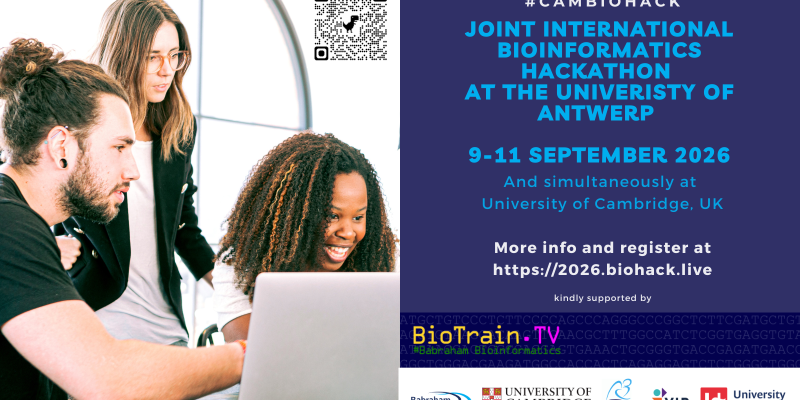
2024 BioHackathon Uni of Cambridge
Café Synthetique Engineering Biology - An Engineer's Perspective & Bioinspired Robotics Uni of Cambridge
The IMA AI/ML Congress 2024 External
Multi-token Prediction and Exploring LM Losses Uni of Cambridge
AI and Statistical Innovations for Palaeoecological Research - 5 day event C2D3 event
Data for Policy 2024 – Decoding the Future: Trustworthy Governance with AI? External
7th Cambridge International Conference on Machine Learning and AI in (Bio)Chemical Engineering Uni of Cambridge
Integrated Cancer Medicine Symposium: ML and AI for Hard-To-Treat Cancers Uni of Cambridge
How FAIRsharing helps you enable FAIR: focus in standards, repositories and policies External
Robust Cancer Early Detection Systems under Distribution Shifts and Uncertainty Workshop C2D3 event
LLM X LAW Hackathon Uni of Cambridge
An Introduction to Diffusion Models in Generative AI Uni of Cambridge
Microsoft AI & Pizza event External
Seminar: Identifying Cancer Risk Early Using AI on Longitudinal Clinical Records Uni of Cambridge
CHIA Annual Conference - AI for Good Uni of Cambridge

Talks

Upcoming related talks from talks@cam

Date Title Organiser Abstract
Title to be confirmed Suchir Salhan Abstract not available
Mechanistic Interpretability - Progress and Limits Mateja Jamnik Abstract not available
Statistics Clinic Lent 2026 IV This free event is open only to members of the University of Cambridge (and affiliated institutes). Please be aware that we are unable to offer consultations outside clinic hours. If you would like to participate, please sign up as we will not be able to offer a consultation otherwise. Please sign up through the following link: https://forms.gle/ffnBjArkRvuLTrp88. Sign-up is possible from Feb 16 midday (12pm) until Mar 2 midday or until we reach full capacity, whichever is earlier. If you successfully signed up, we will confirm your appointment by Mar 4 midday.
TBC Jack Atkinson TBC
Talk by Roger Grosse (University of Toronto) Lucas Resck Exact time TBA
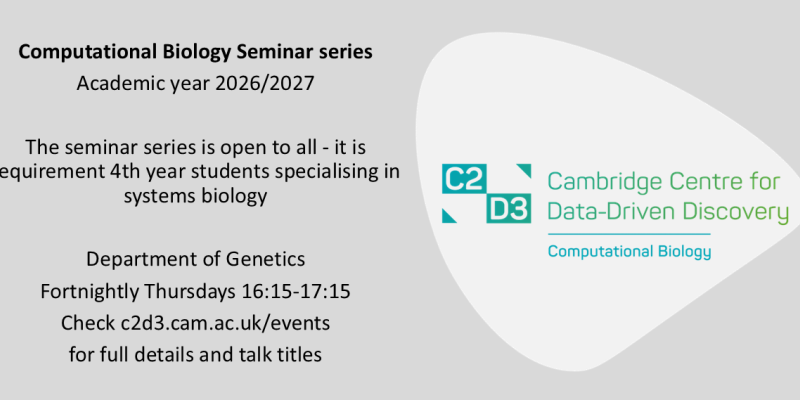
Computational Biology: Seminar Series - Dr Aleksej Zelezniak Ellen Ashmore Dr Aleksej Zelezniak (5 March) Associate Professor, Chalmers University of Technology (Sweden) and King's College London Talk title: tbc Hosted by: Susanne Bornelöv
Title to be confirmed Suchir Salhan Abstract not available
TBC: HPC, GPUs, and Julia Jack Atkinson Abstract not available
Talk by Tal Linzen Lucas Resck Abstract not available
Title to be confirmed Suchir Salhan Abstract not available
Statistics Clinic Lent 2026 V This free event is open only to members of the University of Cambridge (and affiliated institutes). Please be aware that we are unable to offer consultations outside clinic hours. If you would like to participate, please sign up as we will not be able to offer a consultation otherwise. Please sign up through the following link: https://forms.gle/Jx73BwGykJuem4wE7. Sign-up is possible from Mar 12 midday (12pm) until Mar 16 midday or until we reach full capacity, whichever is earlier. If you successfully signed up, we will confirm your appointment by Mar 18 midday.
Talk by Vicente Ordóñez (Rice University) Lucas Resck Exact time TBA
Title to be confirmed Suchir Salhan Abstract not available
Representational Geometry of Language Models Suchir Salhan Abstract not available
How life finds a way: resilience in mammalian embryogenesis Simona Valeviciute Speaker: Sarah Bowling, Ph.D. Assistant Professor in the Department of Developmental Biology at Stanford University School of Medicine​ Title: “How life finds a way: resilience in mammalian embryogenesis​” Abstract: TBC Short bio: Dr. Sarah Bowling is an Assistant Professor in the Department of Developmental Biology at Stanford University School of Medicine. Her laboratory focuses on understanding the mechanisms governing resilience in mammalian embryogenesis - i.e. determining how embryos withstand and recover from diverse genetic and environmental perturbations.
Compositional Design of Society-Critical Systems: From Autonomy to Future Mobility Sally Matthews When designing complex systems, we need to consider multiple trade-offs at various abstraction levels and scales, and choices of single components need to be studied jointly. For instance, the design of future mobility solutions (e.g., autonomous vehicles, micromobility) and the design of the mobility systems they enable are closely coupled. Indeed, knowledge about the intended service of novel mobility solutions would impact their design and deployment process, while insights about their technological development could significantly affect transportation management policies.
A Novel Diffusion Model based Approach for Sleep Music Generation Sam Nallaperuma-Herzberg Sleep disorders, particularly insomnia, and mental health conditions affect a significant fraction of adults worldwide, posing seriousmmental and physical health risk. Music therapy offers promising, low-cost, and non-invasive treatment, but current approaches rely heavily on expert-curated playlists, limiting scalability and personalisation. We propose a low-cost generative system leveraging recent advances in diffusion models to synthesize music for therapy. We focus on insomnia and curate a dataset of waveform sleep music to generate audio tailored to sleep.
"Reinforcement Learning with Exogenous States and Rewards”   Professor Thomas G. Dietterich, School of EECS, Oregon State University Kimberly Cole Exogenous state variables and rewards can slow reinforcement learning by injecting uncontrolled variation into the reward signal. In this talk, I’ll describe our work on formalizing exogenous state variables and rewards. Then I’ll discuss our main result: if the reward function decomposes additively into endogenous and exogenous components, the MDP can be decomposed into an exogenous Markov Reward Process (based on the exogenous reward) and an endogenous Markov Decision Process (optimizing the endogenous reward).
Title to be confirmed Suchir Salhan Abstract not available
Talk by Aaron Mueller (Boston University) Lucas Resck Abstract not available