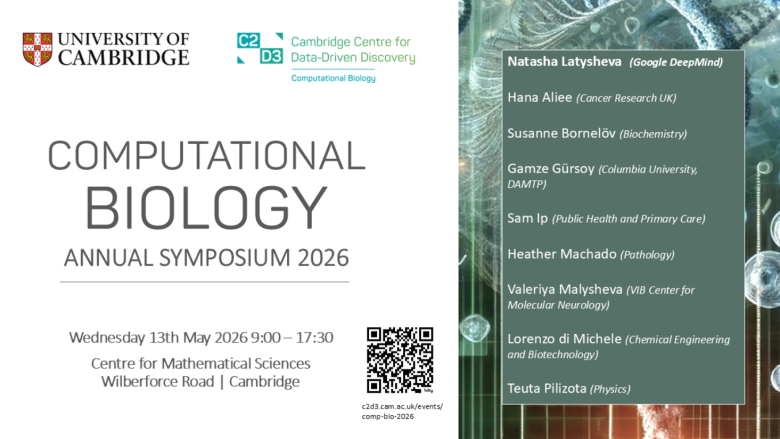
Wed, 13 May 2026 9:00 AM - 5:30 PM
We warmly invite you to the C2D3 Computational Biology Annual Symposium 2026. This event is open to everyone in the Computational Biology Community.
Early Career Researcher: Abstract Submission
We are inviting Early Career Researchers to present their research during the symposium. Talks should be 17 minutes each, and a short Q&A will follow. Please submit your abstract below, ensuring you are free on the symposium day itself and have registered for the event.
Abstract submission now closed.
Registrations
Registration is essential. A waitlist will open if capacity is reached.
Registrations - Now closed.
Be sure to cancel as soon as possible if you find you are no longer able to attend. (see Cancellation terms and conditions).
Programme
09.00-09.20 Registration and refreshments
09.20-09.25 Welcome Gos Micklem (Genetics/DAMTP)
Session 1 - Chair: Valeriya Malysheva (VIB Centre for Molecular Neurology, Antwerp / Computational Biology)
- 09.25-09.45 Anna Foix-Romero (EMBL-EBI/ Biological Sciences) "Invariant Representation Learning for Quantitative Developmental Biology"
- 09.45-10.05 Samantha Ip (Department of Public Health and Primary Care) “Handling missing predictors in external validation of prediction models”
- 10.05-11.05 Keynote: Natasha Latysheva (Google DeepMind) "Advancing regulatory variant effect prediction with AlphaGenome"
11.05-11.25 Break with refreshments
Session 2 - Chair: Siddhartha Kar (Early Cancer Institute)
- 11.25-11.45 Qiuyu Lian (Gurdon Institute/ DAMTP) " VeloTrace Reconciles Divergent Velocity and Trajectory in Single-cell Transcriptomics with Deep Neural ODE"
- 11.45-12.20 Susanne Bornelöv (Biochemistry) "A foundation model to study the molecular principles of post-transcriptional gene regulation"
- 12.20-12.55 Valeriya Malysheva (VIB Centre for Molecular Neurology, Antwerp / Computational Biology)
12.55-13.35 Lunch
Session 3 - Chair: Gos Micklem (Genetics/DAMTP)
- 13.35-14.10 Heather Machado (Pathology) "Using somatic mutations to study the adaptive immune system in ageing and disease"
- 14.10-14.45 Teuta Pilizota (Physics) "Mathematical and Physical Approaches to understanding Bacteria"
14.45-15.05 Break with refreshments
Session 4 - Chair: Heather Machado (Pathology)
- 15.05-15.40 Hana Aliee (Cancer Research UK, Cambridge Institute) "Learning and Reasoning About Cellular Identity in Disease"
- 15.40-16.15 Lorenzo di Michele (Chemical Engineering & Biotechnology)
- 16.15-16.50 Gamze Gürsoy (Biomedical Informatics, Columbia University; from April 2026 DAMTP) "Privacy and Knowledge Discovery with Genome Graphs"
16.50-17.30 Drinks reception
Speaker Biographies
Hana Aliee
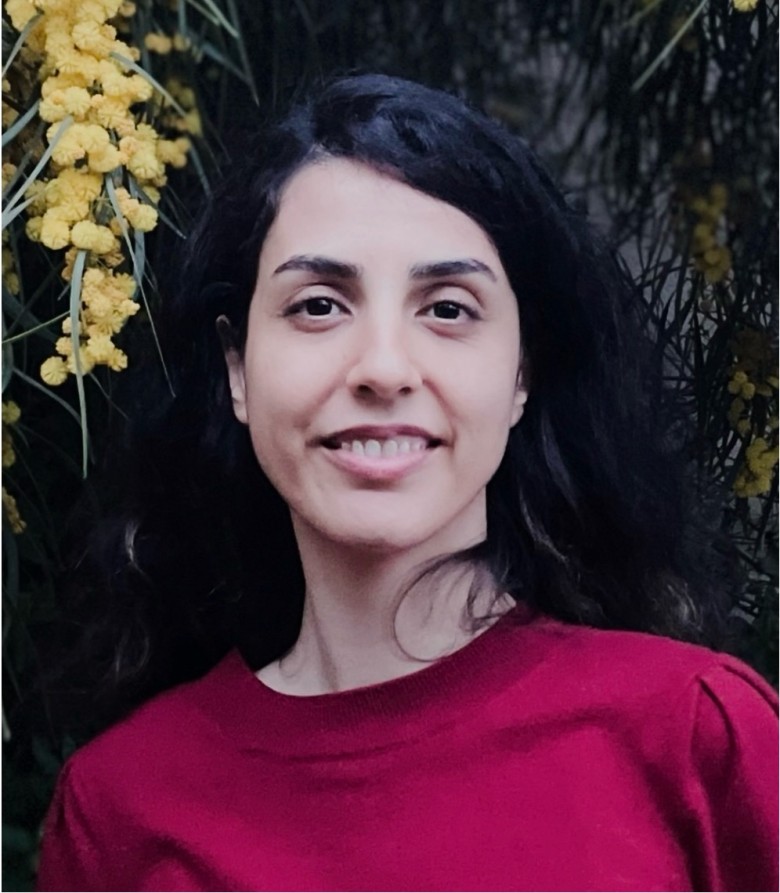
I am a Group Leader in Artificial Intelligence at Cancer Research UK, University of Cambridge, where my lab develops foundational AI methods for scientific discovery and interactive hypothesis generation in cancer. Our work seeks to uncover the molecular mechanisms underlying disease, with a focus on understanding cellular and patient heterogeneity and on guiding biological systems toward desired therapeutic outcomes. I hold a PhD in Computer Science and trained as a computational biologist during postdoctoral research at the Helmholtz Center in Munich and the Wellcome Sanger Institute, with a research focus on multimodal data integration, causal modelling of disease mechanisms, and generative modelling for patient stratification and treatment response prediction.
Susanne Bornelöv
I obtained a PhD in Bioinformatics in 2014 from Uppsala University, Sweden. During my PhD, I developed expertise in machine learning methods for genomics data and focused on understanding the role of histone modifications in gene regulation. To gain more experience in genomic methods, I joined Prof Leif Andersson's group at Uppsala University as a postdoc. Here, I worked on mapping genes to function in domesticated chickens using high-throughput sequencing data. I then moved to Cambridge and joined the Cambridge Stem Cell Institute where I spent four years with Prof Michaela Frye, focusing primarily on RNA modifications and their impact on translation. When Prof Frye's lab relocated to Germany, I joined Prof Greg Hannon's group at the neighbouring institute to strengthen my skills in RNA biology and sequencing-based approaches through studies of the piRNA pathway. Supported by a Wellcome Career Development Award, I now lead a group at the Department of Biochemistry using AI and other data-driven approaches to better understand genome organisation and regulation, with a specific focus on post-transcriptional gene regulation.
https://www.sblab.uk
https://www.bioc.cam.ac.uk/research/faculty/susanne-bornelov
https://bsky.app/profile/susbo.bsky.social
Anna Foix Romero
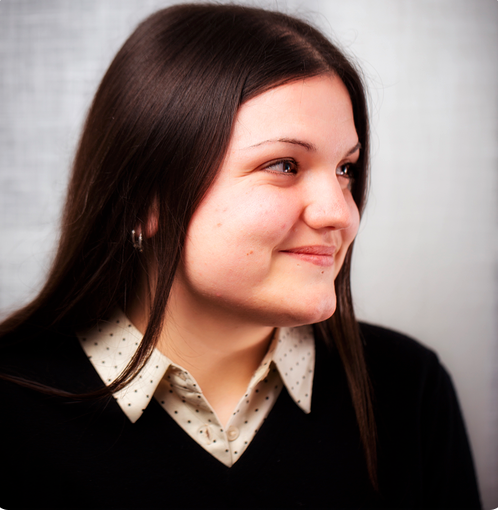
I am a computer scientist and mathematician who began my career as a scientific software engineer, working on genomics and artificial intelligence. My work bridges the gap between computational techniques and biological research using AI. I am currently pursuing a PhD at the European Bioinformatics Institute (EBI) and the University of Cambridge under the supervision of Virginie Uhlmann. My research focuses on developing a framework for shape quantification in microscopy images using generative models, deep learning, and representation learning approaches. My primary interest lies in employing mathematics and machine learning to uncover and enable biological insights from complex bioimages.
Gamze Gursoy

I am an Assistant Professor of Computational Biology in the Department of Applied Mathematics and Theoretical Physics (DAMTP) at the University of Cambridge. My lab focuses on developing algorithmic and machine learning approaches to address key challenges in biology and medicine. Our research aims to uncover the molecular mechanisms underlying gene dysregulation through functional genomics data, quantify and mitigate privacy risks associated with sharing and analyzing omics datasets, and integrate clinical and genetic information to improve the precision of patient phenotyping. We design adaptable computational methods that keep pace with emerging data modalities and analytical demands, with particular emphasis on privacy-preserving analysis and knowledge extraction. I lead a multidisciplinary team of computational and experimental researchers and foster cross-disciplinary training opportunities within the group.
Sam Ip
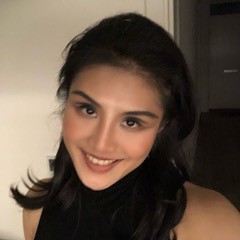
I am an Assistant Research Professor in the Department of Public Health and Primary Care, University of Cambridge. I work across the Cardiovascular Epidemiology Unit and the Centre for Cancer Genetic Epidemiology, and am also affiliated with the Cambridge Centre for AI in Medicine (CCAIM). My work combines methods development and applied analyses using whole-population electronic health records (EHRs). Methodological interests include causal inference, associational analyses, prediction modelling (including dynamic prediction), and missing-data methodology, with emphasis on statistical and computational efficiency for population-scale analyses, including implementation in trusted research environments under computational constraints. Application areas include COVID-19 impact and early cancer detection. I trained in mathematics (MMath, University of Cambridge) and theoretical physics (PhD, Max-Planck-Institut für Astrophysik).
https://www.phpc.cam.ac.uk/staff/dr-samantha-ip
Natasha Latysheva
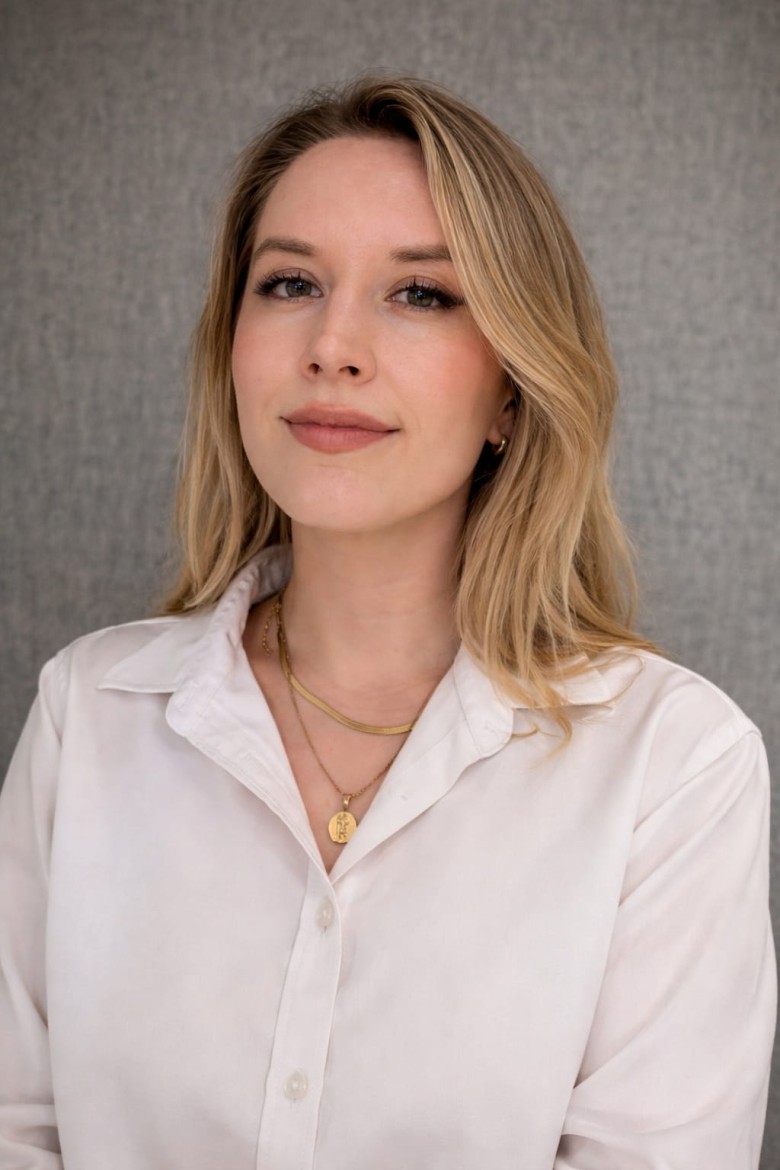
I am a Senior Research Engineer in the Genomics Initiative at Google DeepMind in London. My work focuses on integrating deep learning with molecular biology and genomics, particularly in understanding regulatory DNA and predicting variant effects. I hold a PhD in computational biology from Cambridge University and a Biochemistry BSc from St Andrews University. Before joining DeepMind, I worked in data science and machine learning roles in gaming and natural language processing.
Qiuyu Lian
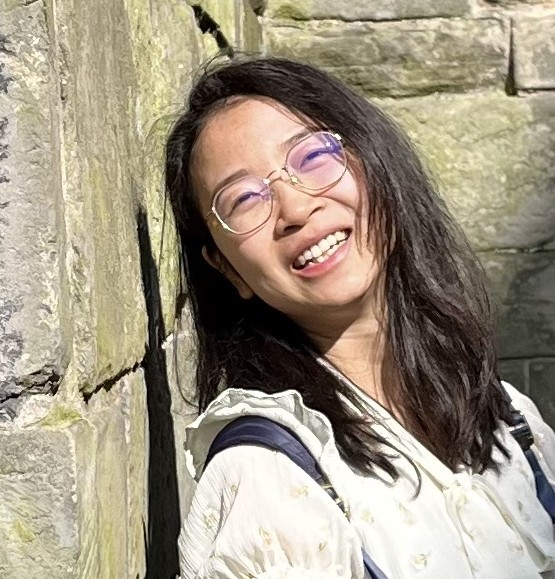
I am an Assistant Research Professor at the Gurdon Institute, University of Cambridge. My research focuses on understanding cell fate decisions and stem cell dynamics through the integration of AI, mathematics, and omics data analysis. I am particularly interested in how stem cell behaviours emerge across development, tissue homeostasis, regeneration, ageing, and tumourigenesis. My work develops and applies computational approaches, including machine learning, dynamical systems, and topology-inspired methods, to uncover the principles underlying cellular state transitions. I trained in engineering (BEng, Sichuan University) and bioinformatics (PhD, Tsinghua University).
Heather Machado

I am interested in the role of the adaptive immune system in ageing and disease, particularly cancer. My background is in evolutionary genomics, having studied population genomics and genome evolution during my PhD at Stanford University and somatic genomics during my postdoc at the Wellcome Sanger Institute. I approach this from the lens of somatic evolution. I use somatic mutations and evolutionary genetic methods to study the co-evolution of immune and non-immune cells, elucidating the role of the adaptive immune system in cancer progression and ageing.
Valeriya Malysheva
I obtained my PhD in molecular biology and have extensive dual experimental and computational expertise in the field of nuclear organisation, integrative systems, computational and mathematical biology. During my postdoctoral research at the University of Cambridge and UKRI Laboratory of Medical Sciences, I developed and patented a novel experimental method for profiling chromosomal interactions in ultra-low input settings. This technology formed the basis of a biotech start-up in Cambridge, Enhanc3D Genomics, which recently secured major series A funding. I also developed novel statistical methods for detection, differential analysis, and multi-modal integration of chromatin conformation capture techniques. Our Computational Neurobiology lab addresses fundamental questions in chromatin organization, epigenetics and brain biology. My team develops statistical and AI approaches for large-scale data integration and reconstruction of cis-regulatory networks underlying cellular decision-making in health and neurodegenerative disease.
Lorenzo Di Michele
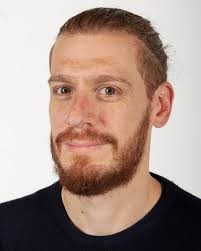
I completed my undergraduate and master’s degrees in physics at the University of L'Aquila (Abruzzo, Italy) in 2010, before moving to the Cavendish Laboratory, University of Cambridge to start my PhD in soft condensed matter physics. After graduating in 2013, I took up an Oppenheimer Early Career Research Fellowship, followed by a Leverhulme Early Career Research Fellowship in 2016 and a Royal Society University Research Fellowship in 2018. The following year, I was awarded an ERC starting grant and moved to the Department of Chemistry at Imperial College London as Lecturer and then Senior Lecturer, before returning to the University of Cambridge, Department of Chemical Engineering and Biotechnology as Assistant Professor in Biotechnology in 2022. Since 2024, I have held a Professorship of Bionanoscience. My research group applies the toolkit of nucleic acid nanotechnology to designing advanced biomimetic systems, applicable as biophysical models or tackling challenges in biomedicine.
Teuta Pilizota
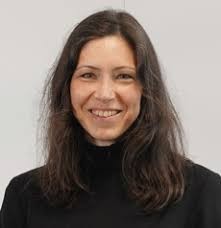
I completed my diploma in physics at the University of Zagreb before moving to do a DPhil in single-molecule biophysics at the University of Oxford. In 2008 I commenced postdoctoral work at Princeton University, where I established the experimental and theoretical framework needed to study bacterial pressure regulation at a single-cell level. In 2013 I was appointed a Chancellor’s Fellow at the University of Edinburgh where I established my research laboratory. I was appointed a Professor of Biophysics at the University of Edinburgh in August 2020 and moved to Cavendish Laboratory in 2024. My lab is a biological physics lab that focuses predominantly on energy generation and pressure regulation through ion flows in unicellular organisms such as bacteria. Developing novel experimental and theoretical tools for the purpose, including state-of-the-art fluorescence imaging techniques, microfluidic devices and optical trapping techniques. While mostly driven by basic research questions we also translate our findings into real-world solutions, including co-founding startup and spinout companies.
https://pilizotalab.bio.ed.ac.uk/
Organising committee
Siddhartha Kar, Heather Machado, Valeriya Malysheva, Gos Micklem & C2D3
Cancellation and No-shows
Please let us know as soon as possible if your plans have changed and you are no longer able to attend. We operate a waiting list for spaces. You should note our Cancellation and No-Show policy, summarised below.
- Delegates who have registered to attend but did not turn up to the event on the day, may be charged a conference fee.
- Charges may be given if less than 7 days' notice is given to the conference organisers.