Thu, 3 Sep 2026 1:00 PM - 2:00 PM
This bi-monthly seminar series explores real-world applications of physics-informed machine learning (Φ-ML) methods to the engineering practice. They cover a wide range of topics, offering a cross-sectional view of the state of the art on Φ-ML research, worldwide.
Speaker: Davide Murari
Many dynamical systems exhibit non-smooth dynamics, including friction, contact, impacts, saturation, and switching. Standard machine-learning approaches for system identification often assume smooth vector fields, and may therefore smooth out precisely the mechanisms that control the qualitative behaviour of these systems. In this talk, I will discuss a structure-informed approach for discovering piecewise-smooth dynamical systems from trajectory data.
The key idea is to separate the problem into two coupled tasks. First, we infer the switching geometry from the observed trajectories. In particular, we use signatures of non-smooth behaviour, such as abrupt changes in the observed velocity field, to identify candidate points on the discontinuity set and recover approximate switching manifolds. Second, once this geometry has been estimated, we learn the smooth dynamics in the regions separated by the switching set. This leads to a neural representation of the vector field that is compatible with the recovered non-smooth structure, rather than a fully black-box neural ODE.
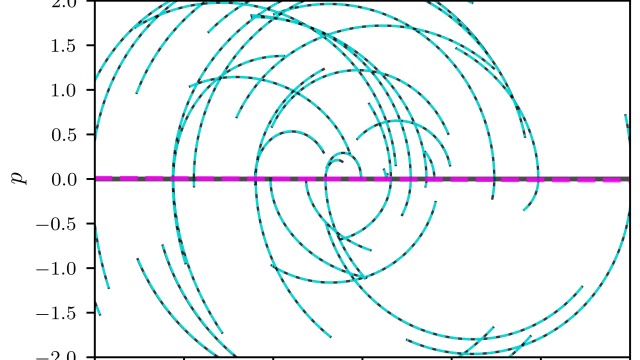
I will illustrate the approach on benchmark Filippov systems, including a dry-friction oscillator, where the goal is to recover both the switching manifold and the region-wise dynamics from trajectory observations. The broader aim is to show how physical structure can be used not only as a regulariser, but also as a modelling principle for interpretable data-driven discovery of non-smooth engineering dynamics.
Find out more and register to attend at: Phi-ML meets Engineering - Physics-informed discovery of non-smooth dynamical systems from trajectory data | The Alan Turing Institute