Events 32 x 13.1 ( with space) ppt.png

Events and Talks


In AI, Machine Learning and Data Science across the University and beyond.

Events

C2D3 event Talk In person

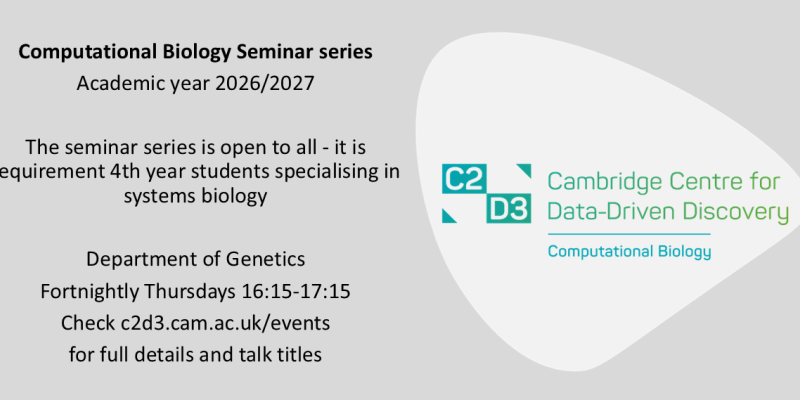
Computational Biology: Seminar Series

8 Oct 2026 - 18 Mar 2027

C2D3 event Talk In person

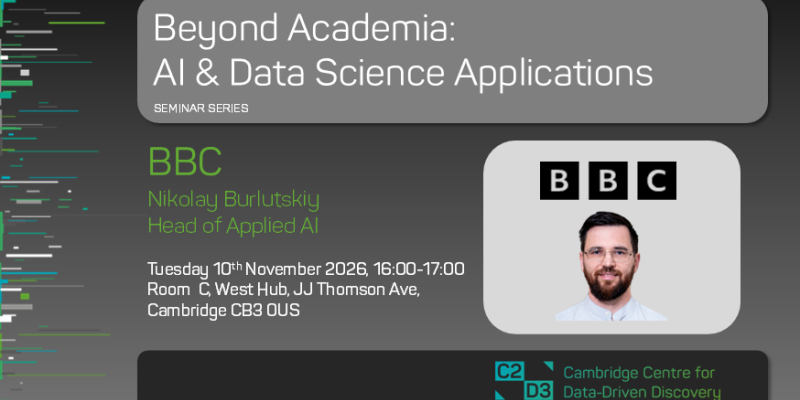
Beyond Academia - BBC, Head of Applied AI

10 Nov 2026

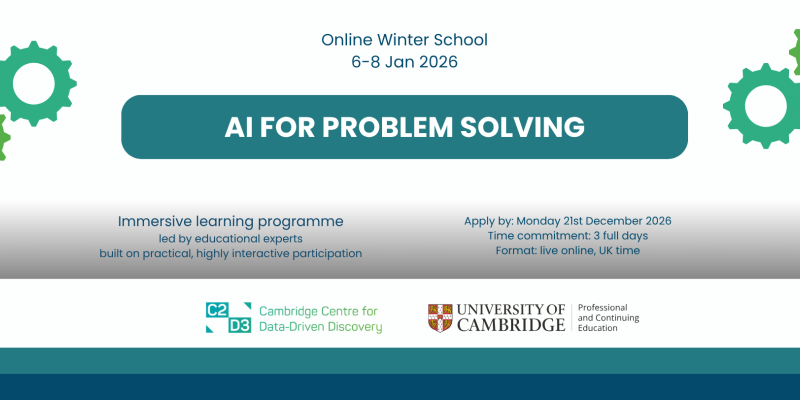
6 Jan 2027 - 8 Jan 2027

Uni of Cambridge Workshop In person

Accelerate Programme: Michaelmas Term training workshops

14 Sep 2026 - 11 Nov 2026

11 Nov 2026

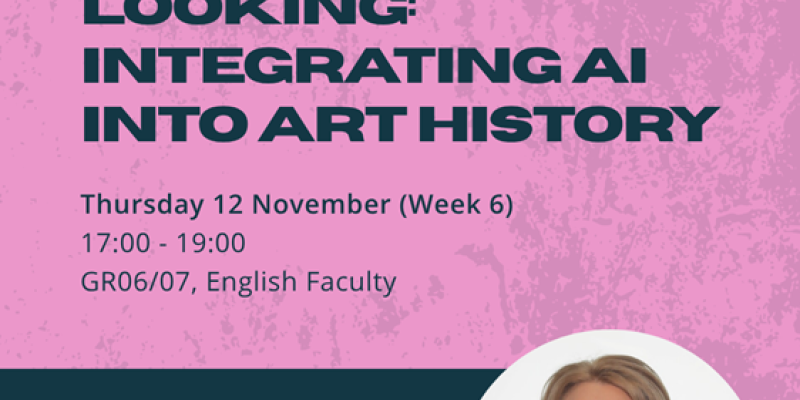
12 Nov 2026

19 Nov 2026

Uni of Cambridge Conference Hybrid

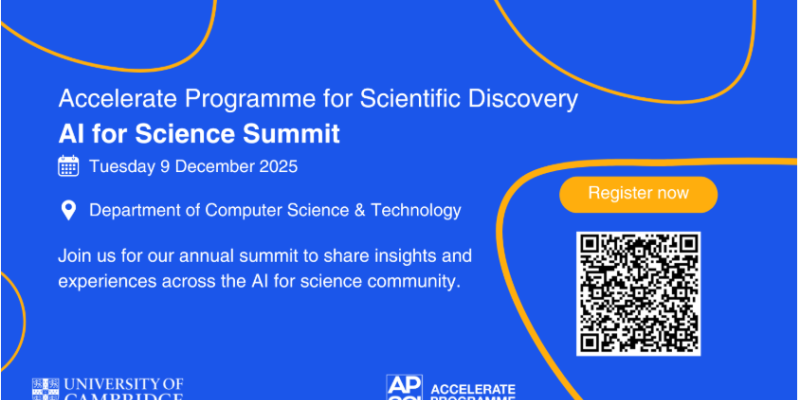
AI for Science Summit 2026

24 Nov 2026

9 Dec 2026 - 10 Dec 2026

11 Jan 2027 - 15 Jan 2027

External Conference In person

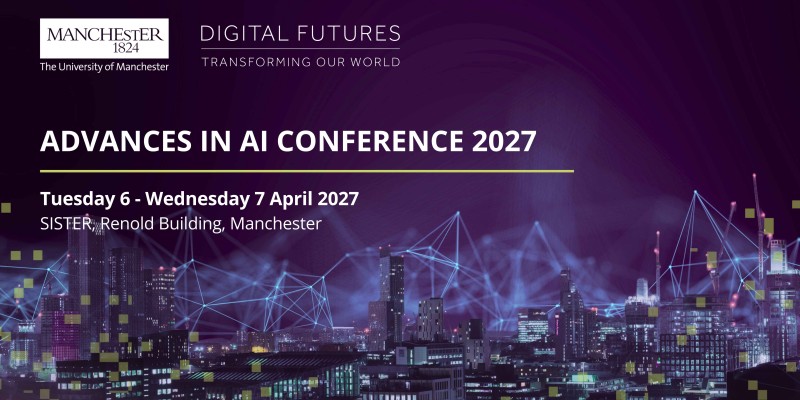
Advances in AI Conference 2027

6 Apr 2027 - 7 Apr 2027

University of Cambridge Mathematics and Big Data Showcase
The Alan Turing Institute – Energy Summit
Our Digital Future - Multidisciplinary Perspectives on Long Term Data…
Big Data, Multimodality & Dynamic Models in Biomedical Imaging
EPSRC Centre for Mathematical and Statistical Analysis of Multimodal…
Ethics of Big Data in practice: Social media research
Ethics of Big Data in practice: Administrative data
Ethics of Big Data in practice: Patient record linkage in hospitals
Ethics of Big Data in practice: Health and Policy research in Africa
Workshop on Urban Data Science #wuds15
Neurocomputation: from brains to machines
Big Data for Small and Medium Enterprises - an Alan Turing Institute Summit
Inside Snowden’s suitcase
Regulation of medical research under European Data Protection: in theory and practice…
What is Big Data? Discovery through a Data Walkshop
Green Computing - Materials, Architectures and Applications
Big Data Methods for Social Science and Policy - Interdisciplinary Workshop Programme…
Data In Drug Discovery - Time To Get Honest!
Data and Sensing in Extreme Environments
Big Data in Medicine: Exemplars and Opportunities in Data Science
Policy-Making in the Big Data Era: Opportunities & Challenges
Economic and Econometric Applications of Big Data
Selling Science? News, public relations and communicating scientific research
Social Media and Qualitative Health Research: Big Data Seminar and Masterclass
Tenth Annual Symposium of the Cambridge Computational Biology Institute
Cambridge Networks Day 2015
Human-Data Interaction
Data and Digital Innovation in Enabling Servitization (ESRC/BAE Systems…
Data and Life on Tenison Road
The Vocabulary of Big Data External
The Future of Economics and Public Policy External
Privacy, public interest and the future of healthcare research External

Talks

Upcoming related talks from talks@cam

Date Title Speaker Abstract
Beyond Academia - BBC, Head of Applied AI Nikolay Burlutskiy, Head of Applied AI, BBC

The Beyond Academia: AI & Data Science Applications seminar series at the University of Cambridge explores the transformative role of data and artificial intelligence in the world. Designed for postgraduate researchers, early-career academics, and students, the series bridges the gap between high-level research and real-world deployment.

BSU Seminar-"Hierarchical Causal Models" This is a free seminar- to attend remotely please use the following link: https://teams.microsoft.com/meet/3978637967598328?p=nw8RVurjolXhkz4sKy David Blei, Columbia University

Hierarchical Causal Models


David Blei

Columbia University


Title to be confirmed Jindřich Libovický (Charles University)


Neural networks for scientific discovery: hard-won insights Alex Matthew (cusp.ai)

Neural networks are powerful function approximators, but turning that flexibility into scientific discovery often requires a great deal of additional work. In this talk I will discuss two projects applying neural networks to partial differential equations. Although the applications and methods differ, they offer shared lessons about mathematical structure, and optimisation.


Expander Datacenters: From First Principles to the Cloud Prof. Michael Schapira, Hebrew University of Jerusalem

Abstract:

Statistics Clinic Michaelmas 2026 III

This free event is open only to members of the University of Cambridge (and affiliated institutes). Please be aware that we are unable to offer consultations outside clinic hours.


Title to be confirmed Anne-Marie Lutgen (University of Luxembourg)


MRC Biostatistics Unit seminar Pawel Morzywolek, University of Copenhagen

Inference on Variable Importance for Treatment Effect Heterogeneity: Shapley Values and Beyond


How Do Language Models Reason? Foundations, Limitations and Neuro-Symbolic Approaches André Freitas (Idiap Research Institute & University of Manchester)

How do language models reason, and what would it take to build AI systems capable of sustained, complex reasoning? This lecture develops the foundations for answering these questions, connecting what we know about the internal workings of language models with methods for evaluating and extending their capabilities.


Optimising Julia code on GPUs: Case studies from ocean and atmosphere modelling Mikolaj Kowalski, Jack Franklin, David Kamm - RSEs, ICCS, University of Cambridge

Julia is a just-in-time (JIT) compiled language with a strong focus on scientific computing and performance. It has gained significant popularity in the climate science community, largely due to its flexibility and excellent native support for GPU computing. Over the last year, our team at the Institute for Computing for Climate Science (ICCS) has collaborated closely with the developers of major Julia-based ocean and atmosphere models to optimize their performance on GPU architectures.

Optiver.com


ALPS: An Efficient Request Scheduler for LLM Inference Dr Chen Chen, Nottingham Trent University

Abstract:

Aligning LLMs to the Human Brain Mariya Toneva (Max Planck Institute for Software Systems)


Title to be confirmed Bálint Gyevnár (CMU)


Amazon.com Amazon.com


Scaling Analytical Benchmarks to Production Complexity   Jan Vincent Szlang, University of Cambridge

Abstract:

Red teaming frontier AI at the UK AI Security Institute M. Pawan Kumar (AI Security Institute)

Abstract: The UK’s AI Security Institute (AISI), situated within the Cabinet Office, works to equip government with an evidenced understanding of the risks posed by advanced AI. AISI's Red Team stress-tests frontier safety measures: finding ways misuse safeguards can fail, investigating unintended and harmful model behaviours, and assessing whether protocols intended to keep models under control actually work.


Statistics Clinic Michaelmas 2026 IV

This free event is open only to members of the University of Cambridge (and affiliated institutes). Please be aware that we are unable to offer consultations outside clinic hours.
Validity by Design for LLM "Reasoning" Rachel Lawrence (Microsoft Research Cambridge)


QBS - Dr Alexis Barr Dr Alexis Barr, Imperial College London

Title: Discovery research for better cell cycle targeting in cancer