Events 32 x 13.1 ( with space) ppt.png

Events and Talks


In AI, Machine Learning and Data Science across the University and beyond.

Events

C2D3 event Talk In person

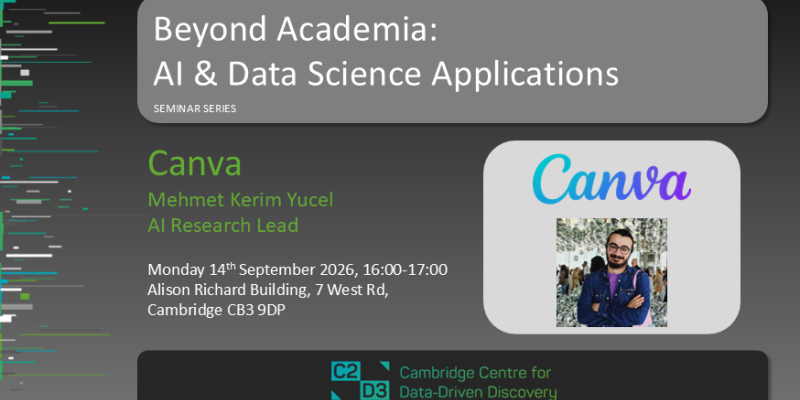
Beyond Academia - Canva, AI Research Lead

14 Sep 2026

27 Oct 2026

C2D3 event Talk In person

Beyond Academia - BBC, Head of Applied AI

10 Nov 2026

7 Sep 2026 - 11 Sep 2026

7 Sep 2026 - 11 Sep 2026

Uni of Cambridge Workshop In person

Accelerate Programme: Michaelmas Term training workshops

14 Sep 2026 - 11 Nov 2026

External Conference In person

The Fourth UK AI Conference 2026

29 Sep 2026 - 30 Sep 2026

Uni of Cambridge Conference In person

AI for Science Summit 2026 : Save the Date

24 Nov 2026

CDH Open: Digital Editing in the Age of AI | Dr James Cummings
Prof. Max Kleiman-Weiner: Computational morality
Women in Robotics
Accelerate Programme AI for Science lunchtime seminar Uni of Cambridge
Large Language Models in Practice: A Hands-On Journey from Data Collection to Insight Discovery Uni of Cambridge
Accelerate Programme for Scientific Discovery – Michaelmas Term workshops in AI for Science Uni of Cambridge
Synthetic Biology UK 2024 Uni of Cambridge
Validation data: strategies to avoid overuse (Invitation only workshop) C2D3 event
AI for Science Summit, University of Cambridge Uni of Cambridge
AI and Science: An opportunity to strengthen the African scientific landscape Uni of Cambridge
How can we make public health more precise? Uni of Cambridge
Illuminating mechanisms of mammalian morphogenesis Uni of Cambridge
Communicating Mathematical and Data Sciences – What does Success Look Like? External
Ideas to Reality Programme Uni of Cambridge
Generative models as efficient surrogates for molecular dynamics simulations Uni of Cambridge
IE Expo Uni of Cambridge
Cambridge MedAI Seminar Series Uni of Cambridge
Digital Twins of Patients on Non-Invasive Respiratory Support Uni of Cambridge
Domain-theoretic Semantics for Dynamical Systems: From Analog Computers to Neural Networks Uni of Cambridge
Continuous Diffusion for Mixed-Type Tabular Data Uni of Cambridge
The next frontier in causal machine learning Uni of Cambridge
Computational Microbiology of the E. coli cell envelope Uni of Cambridge
AI and Mental health Uni of Cambridge
Founders at the University of Cambridge - Introducing Start 2.0 Uni of Cambridge
Cell state switches and local adaptation in cancer: insights from AI and ecology-inspired approaches Uni of Cambridge
When tech policy becomes foreign policy: the future global governance of AI – Trust Conference 2024 Uni of Cambridge
Functional genomic screens and AI: a key partnership for successful therapeutic development External
Cambridge Infectious Diseases ECR event: Exploring Career Pathways Uni of Cambridge
Somatic evolution of the adaptive immune system in health and disease Uni of Cambridge
CHIA Early Career Community Welcome Event Uni of Cambridge
Efficient protein flow models with optimal transport flow matching Uni of Cambridge
ARIA Roadshow in Cambridge External
C2D3 ECR and student conference 2024 C2D3 event
2024 BioHackathon Uni of Cambridge
Café Synthetique Engineering Biology - An Engineer's Perspective & Bioinspired Robotics Uni of Cambridge
The IMA AI/ML Congress 2024 External
Multi-token Prediction and Exploring LM Losses Uni of Cambridge
AI and Statistical Innovations for Palaeoecological Research - 5 day event C2D3 event
Data for Policy 2024 – Decoding the Future: Trustworthy Governance with AI? External
7th Cambridge International Conference on Machine Learning and AI in (Bio)Chemical Engineering Uni of Cambridge
Integrated Cancer Medicine Symposium: ML and AI for Hard-To-Treat Cancers Uni of Cambridge
How FAIRsharing helps you enable FAIR: focus in standards, repositories and policies External
Robust Cancer Early Detection Systems under Distribution Shifts and Uncertainty Workshop C2D3 event
LLM X LAW Hackathon Uni of Cambridge
An Introduction to Diffusion Models in Generative AI Uni of Cambridge
Microsoft AI & Pizza event External
CHIA Annual Conference - AI for Good Uni of Cambridge
Seminar: Identifying Cancer Risk Early Using AI on Longitudinal Clinical… Uni of Cambridge
Networking and talks: AI for better brain and mental health External
Workshop (online): Introduction to data management for peatland research and monitoring External

Talks

Upcoming related talks from talks@cam

Date Title Speaker Abstract
What Do Sheaf Neural Networks Learn? A Curvature Decomposition for Cellular Sheaves Francesco Guadagnuolo

Sheaf Neural Networks generalise graph message passing by attaching a vector space to each node and a linear map to each incidence, and were introduced to mitigate oversmoothing and to handle heterophilic graphs. Most of what is known about them concerns the limit of sheaf diffusion, described by the Hodge decomposition, while the sheaf that the network actually learns remains largely opaque.

Beyond Academia - Canva, AI Research Lead Mehmet Kerim Yucel, AI Research Lead, Canva

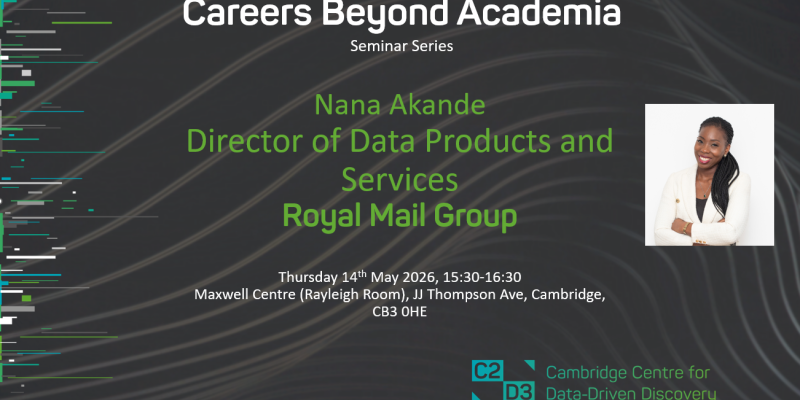
The Beyond Academia: AI & Data Science Applications seminar series at the University of Cambridge explores the transformative role of data and artificial intelligence in the world. Designed for postgraduate researchers, early-career academics, and students, the series bridges the gap between high-level research and real-world deployment.


Beyond Academia - Novo Nordisk, Head of AI Governance & Enablement Margi Sheth, Head AI Governance & Enablement, Novo Nordisk

The Beyond Academia: AI & Data Science Applications seminar series at the University of Cambridge explores the transformative role of data and artificial intelligence in the world. Designed for postgraduate researchers, early-career academics, and students, the series bridges the gap between high-level research and real-world deployment.
Beyond Academia - AstraZeneca, Director of Data Science Skills and Partnerships Vera Hazelwood, Director of Data Science Skills and Partnerships, AstraZeneca

The Beyond Academia: AI & Data Science Applications seminar series at the University of Cambridge explores the transformative role of data and artificial intelligence in the world. Designed for postgraduate researchers, early-career academics, and students, the series bridges the gap between high-level research and real-world deployment.
Title to be confirmed Danae Sanchez Villegas (University of Copenhagen)


Understanding Multimodal Reasoning Beyond Final Answers Danae Sanchez Villegas (University of Copenhagen)


BSU Seminar: "Using variability in longitudinally-measured variables as a predictor of health outcomes" Professor Michael Elliott, University of Michigan School of Public Health

Longitudinal data has become a major part of the landscape for clinical and epidemiological research. While variance is typically understood as nuisance – the “noise” in “signal-to-noise” – there is increasing evidence that underlying variability in subject-level measures over time may also be important in predicting future health outcomes of interest.

Title to be confirmed Carolina Scarton


Beyond Academia - Google, Head of Universities, EMEA Partnerships Christina Matteotti, Head of Universities, EMEA Partnerships, Google

The Beyond Academia: AI & Data Science Applications seminar series at the University of Cambridge explores the transformative role of data and artificial intelligence in the world. Designed for postgraduate researchers, early-career academics, and students, the series bridges the gap between high-level research and real-world deployment.
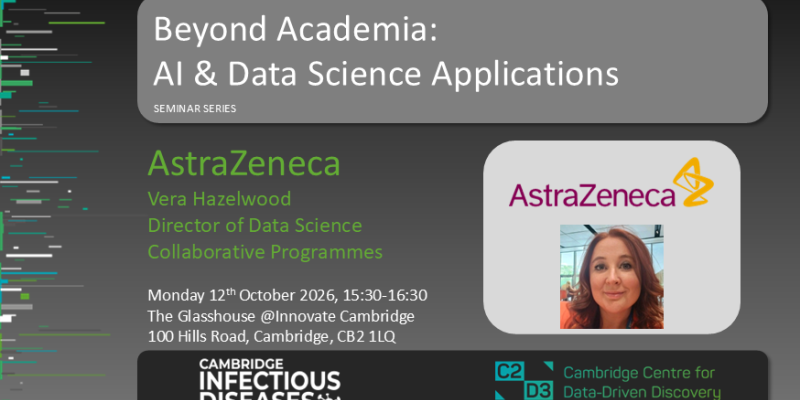
Beyond Academia - Financial Times, Chief Data Officer Kate Sargent, Chief Data Officer, Financial Times

The Beyond Academia: AI & Data Science Applications seminar series at the University of Cambridge explores the transformative role of data and artificial intelligence in the world. Designed for postgraduate researchers, early-career academics, and students, the series bridges the gap between high-level research and real-world deployment.
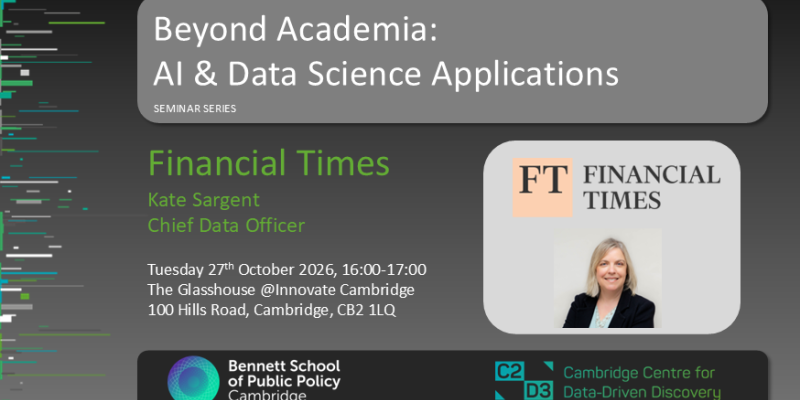
Beyond Academia - BBC, Head of Applied AI Nikolay Burlutskiy, Head of Applied AI, BBC

The Beyond Academia: AI & Data Science Applications seminar series at the University of Cambridge explores the transformative role of data and artificial intelligence in the world. Designed for postgraduate researchers, early-career academics, and students, the series bridges the gap between high-level research and real-world deployment.