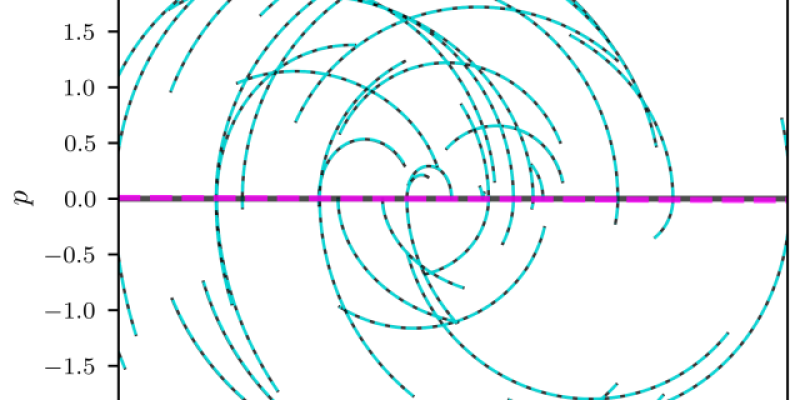
Sheaf Neural Networks generalise graph message passing by attaching a vector space to each node and a linear map to each incidence, and were introduced to mitigate oversmoothing and to handle heterophilic graphs. Most of what is known about them concerns the limit of sheaf diffusion, described by the Hodge decomposition, while the sheaf that the network actually learns remains largely opaque.
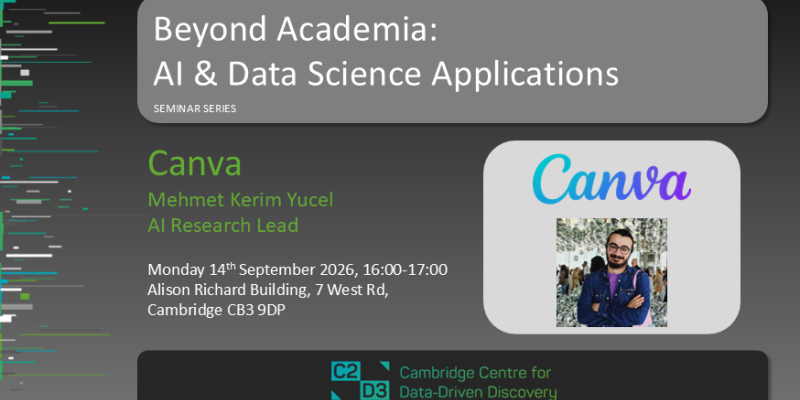
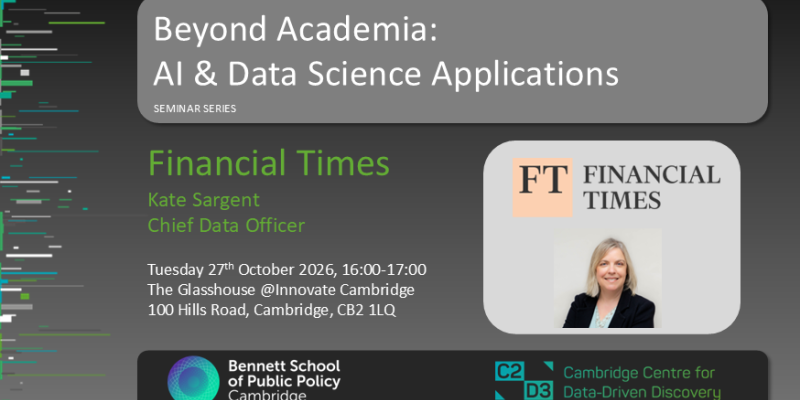
The Beyond Academia: AI & Data Science Applications seminar series at the University of Cambridge explores the transformative role of data and artificial intelligence in the world. Designed for postgraduate researchers, early-career academics, and students, the series bridges the gap between high-level research and real-world deployment.
Margi Sheth, Head AI Governance & Enablement, Novo Nordisk
The Beyond Academia: AI & Data Science Applications seminar series at the University of Cambridge explores the transformative role of data and artificial intelligence in the world. Designed for postgraduate researchers, early-career academics, and students, the series bridges the gap between high-level research and real-world deployment.
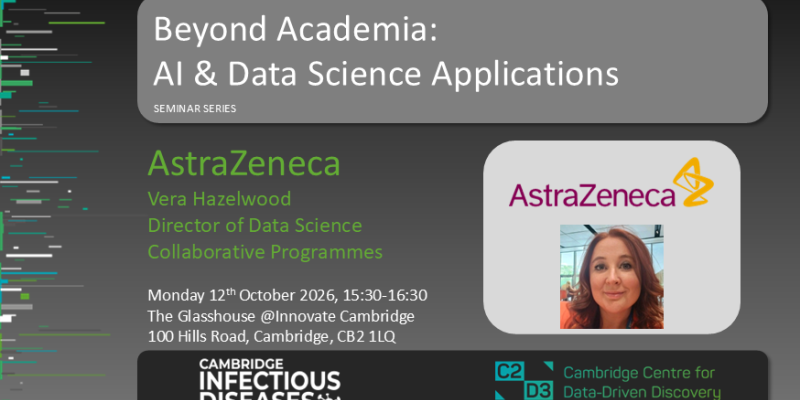
Vera Hazelwood, Director of Data Science Skills and Partnerships, AstraZeneca
The Beyond Academia: AI & Data Science Applications seminar series at the University of Cambridge explores the transformative role of data and artificial intelligence in the world. Designed for postgraduate researchers, early-career academics, and students, the series bridges the gap between high-level research and real-world deployment.
Professor Michael Elliott, University of Michigan School of Public Health
Longitudinal data has become a major part of the landscape for clinical and epidemiological research. While variance is typically understood as nuisance – the “noise” in “signal-to-noise” – there is increasing evidence that underlying variability in subject-level measures over time may also be important in predicting future health outcomes of interest.
Christina Matteotti, Head of Universities, EMEA Partnerships, Google
The Beyond Academia: AI & Data Science Applications seminar series at the University of Cambridge explores the transformative role of data and artificial intelligence in the world. Designed for postgraduate researchers, early-career academics, and students, the series bridges the gap between high-level research and real-world deployment.
The Beyond Academia: AI & Data Science Applications seminar series at the University of Cambridge explores the transformative role of data and artificial intelligence in the world. Designed for postgraduate researchers, early-career academics, and students, the series bridges the gap between high-level research and real-world deployment.
The Beyond Academia: AI & Data Science Applications seminar series at the University of Cambridge explores the transformative role of data and artificial intelligence in the world. Designed for postgraduate researchers, early-career academics, and students, the series bridges the gap between high-level research and real-world deployment.