Chris Edsall - Head of RSE, University of Cambridge
The biggest change recently in the research computing services offerings has been the arrival of Zenith. This system is part of national services AIRR and NCR and will be available to the Cambridge research community. In a departure from previous architectures the CPUs and GPUs on this machine come from AMD. The question is how does one write applications on Zenith, this talk will outline several approaches.
Professor Florian Markowetz (CRUK Cancer Institute)
Professor Markowetz will provide an overview of his group’s research into cancers characterised by highly unstable genomes. He will discuss computational methods developed to understand this genomic chaos and how these approaches can help identify the most effective treatments for patients.
LLM agents are increasingly deployed on long-horizon tasks with tool use, irreversible actions, and unpredictable feedback. Yet we have few principled ways to tell, mid-episode, whether an agent is on track or quietly failing. Most uncertainty quantification (UQ) research still centers on single-turn QA, a poor match for interactive agents. In this talk, I'll present a general formulation of agent UQ and the challenges unique to agentic settings, from choosing uncertainty estimators to modeling how uncertainty evolves over an interaction.
Digital twins combine real-world data with digital representations of physical systems, but building useful digital twins involves more than simply collecting and displaying data. This talk presents my work on developing a real-time digital twin of a smart building, covering the journey from privacy-preserving sensor design and real-time event detection through to data processing and visualisation, and ultimately how these systems are evaluated with the people who use them.
This free event is open only to members of the University of Cambridge (and affiliated institutes). Please be aware that we are unable to offer consultations outside clinic hours.
The division of labor enables us to build complex human and machine systems. Today, decentralized multi-agent systems with learned behavior are becoming more prevalent. At the same time, decentralization can come with a costly price of anarchy—agents learn to behave in ways that leave everyone worse off. Can we understand and guard against collectively irrational behavior? In this work, we formalize a close relationship between rationality (Pareto optimality) and learnability (uniform stability) for mixed Nash equilibria. This result can be understood by analogy with optimization.
How can we create a learning algorithm that generalises “out of distribution”, i.e. beyond the training data? What can we expect about errors when a model generalises OoD? And what should happen when an error is made? In this talk, we will discuss how OccamLab’s approach to these questions. We will discuss solutions that are prescribed by a Bayesian perspective, through work on learning invariance/equivariance properties, uncertainty quantification, and continual learning.
Jack Franklin - RSE, ICCS, University of Cambridge
Video games can be a useful medium for engaging with audiences of all ages. This can be beneficial for scientific outreach activities, to foster interest with members of the public and lower the barrier of entry to more technical topics.
Minh Duc Bui (Johannes Gutenberg University Mainz)
Should multilingual LLMs answer medical questions the same way in every language, or adapt to cultural cues? In this talk, we discuss these two perspectives. Multilingual medical benchmarks typically treat cross-lingual variation as error, while cultural adaptation research argues that appropriate answers can legitimately differ. We dive into prior work, examining which of these perspectives it takes, and identify three gaps: missing stakeholder perspectives, little evidence on which approach serves users better, and no benchmarks that separate universal from culture-specific cases.
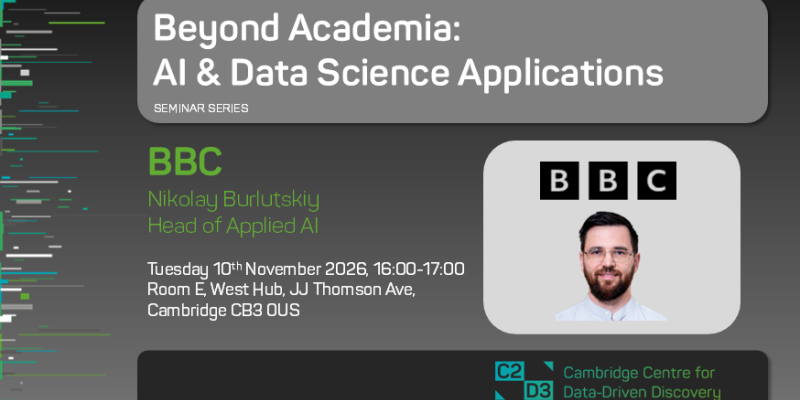
The Beyond Academia: AI & Data Science Applications seminar series at the University of Cambridge explores the transformative role of data and artificial intelligence in the world. Designed for postgraduate researchers, early-career academics, and students, the series bridges the gap between high-level research and real-world deployment.
This free event is open only to members of the University of Cambridge (and affiliated institutes). Please be aware that we are unable to offer consultations outside clinic hours.