
Reflections on last week's Open Minds for Modern Mind Health event
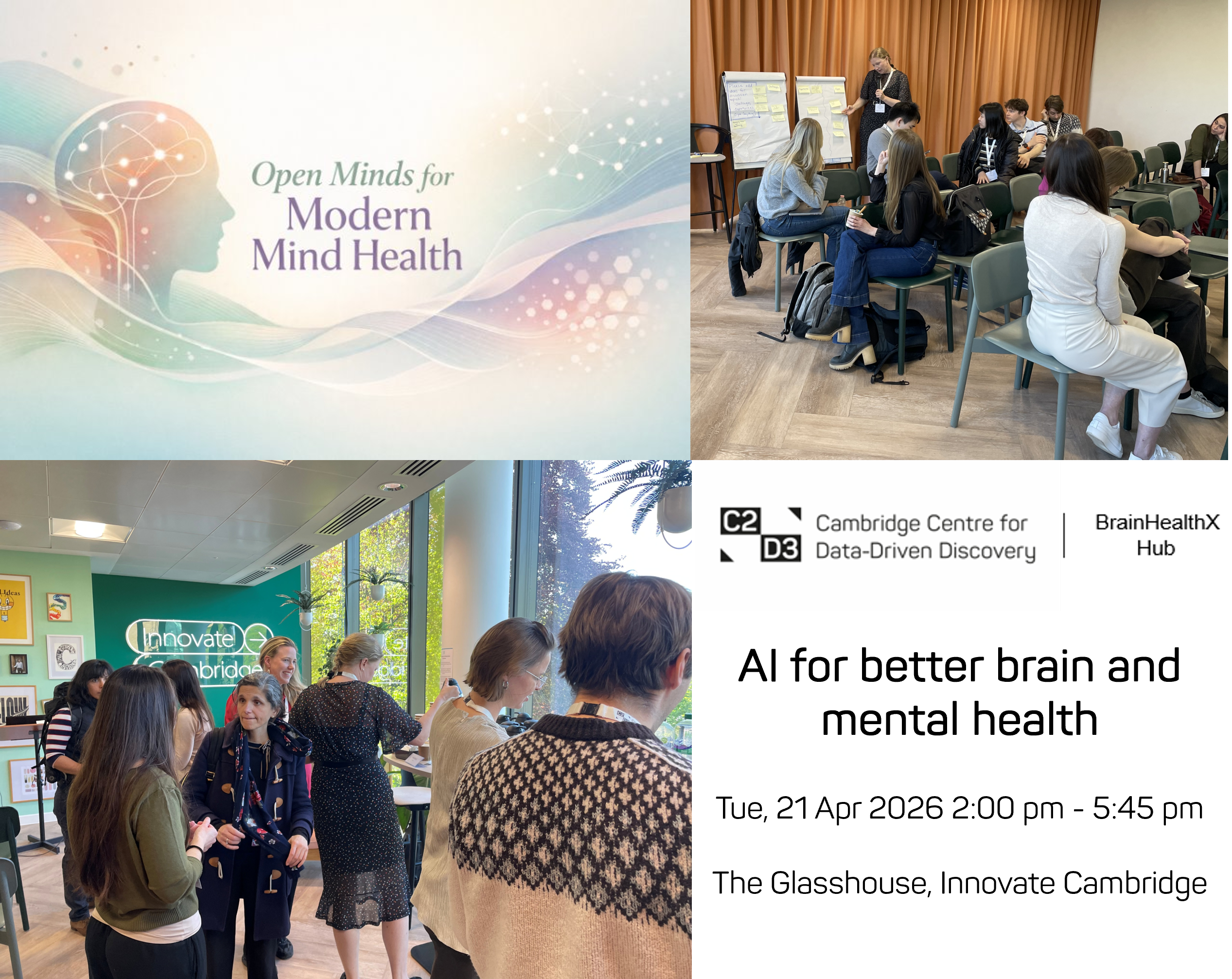
Early-career researchers from across academia and industry gathered at The Glasshouse, Innovate Cambridge for an afternoon of flash talks, open mic discussions and conversation about AI for better brain and mental health. The room brought together postdocs, PhD students, founders and industry researchers, all working at the intersection of AI and brain health, and all keen to hear what the people around them were thinking about.
The open mic sessions were shaped entirely by the people in the room. Attendees suggested topics, voted on the ones they wanted to explore, and led the discussions themselves.
The threads that emerged said a lot about where this field is heading. One explored academia vs industry, and the spaces in between, including the rise of Focused Research Organisations (FROs) as a third path that combines academic rigour with the focus and resourcing of a startup. Another centred on how AI can genuinely accelerate discovery in brain health, where it adds real value, where human insight still leads, and how to build tools clinicians and patients can actually trust. Conversations also turned to funding models that serve discovery rather than distract from it and open data and cross-institutional collaboration, with attendees swapping practical experiences of what's working and where the friction still lies.
A huge thank you to the flash talk speakers, who packed remarkable depth into five minutes each:
🧠 Zahara Gironés Delgado-Urena, From benchmark to bedside: closing the translation gap in brain health AI
🧠 Tracy Wright, Optimising high-performing minds for industry success
🧠 Matthew Cotton, Aggregation dynamics from post-mortem snapshots
🧠 Maya Gavin, Researchers shouldn't spend half their time looking for money
🧠 Dequn Teng, Funding the mind: investment dynamics in the brain health AI startup ecosystem
🧠 Nina Sobierajska, The fUSiON Project: wearable neuroimaging to map neonatal cognitive function
Together, the talks moved from the lab bench to the boardroom, covering translational AI, neuroimaging, protein dynamics, startup ecosystems and the everyday realities of building a research career. The breadth of work on show was a reminder of just how interdisciplinary brain health AI has become, and how much there is to gain from pulling these communities into the same room.
Thanks to the organising committee, Máiréad Healy, Liz Yuanxi Lee, Rachel Sippy, Angela Godoy, Ellen Ashmore Marsh and Alison Wilson, and to the BrainHealthX Hub for partnering with C2D3 on a format built around early-career researchers. Looking forward to the next one!