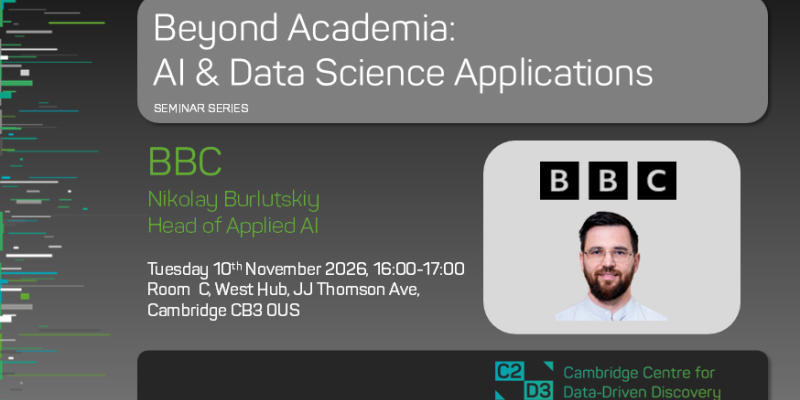
Can smaller language-model agents compete with larger, more expensive ones? On short tasks the gap is small, but it widens sharply on longer-horizon workflows. This talk presents Strategy Auctions for Workload Efficiency (SALE), where the agents’ own plans become both a routing signal and a learning signal, letting small agents improve and take on more of the work over time. On deep search and coding, SALE outperforms the largest agent in the pool at substantially lower cost.
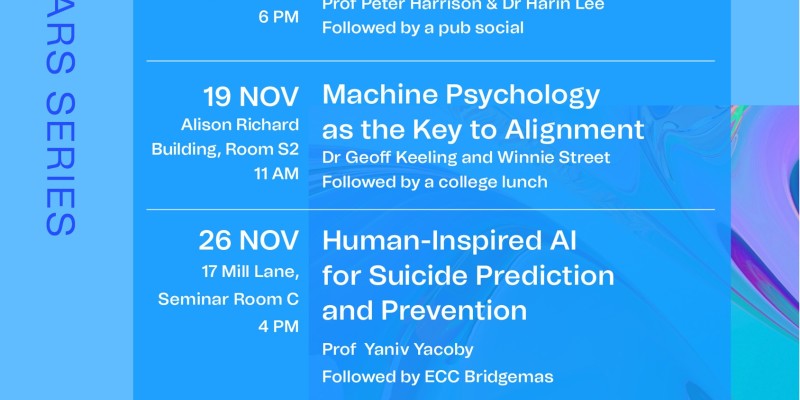
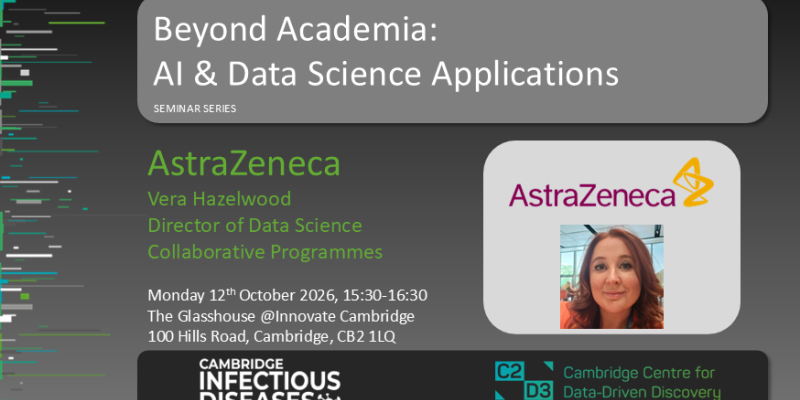
The Beyond Academia: AI & Data Science Applications seminar series at the University of Cambridge explores the transformative role of data and artificial intelligence in the world. Designed for postgraduate researchers, early-career academics, and students, the series bridges the gap between high-level research and real-world deployment.
This free event is open only to members of the University of Cambridge (and affiliated institutes). Please be aware that we are unable to offer consultations outside clinic hours.
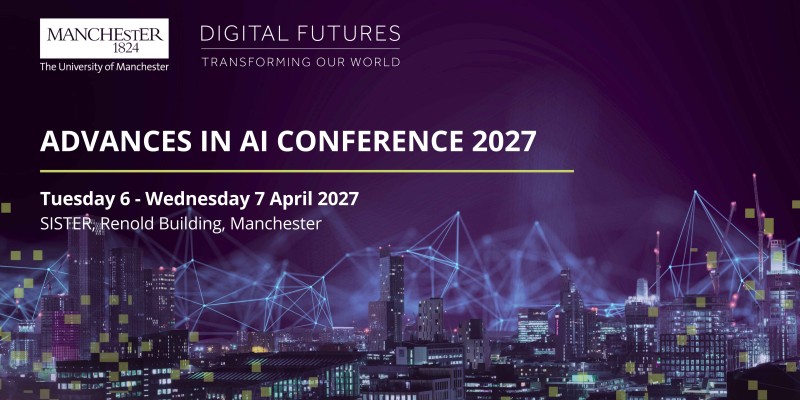
André Freitas (Idiap Research Institute & University of Manchester)
How do language models reason, and what would it take to build AI systems capable of sustained, complex reasoning? This lecture develops the foundations for answering these questions, connecting what we know about the internal workings of language models with methods for evaluating and extending their capabilities.
Mikolaj Kowalski, Jack Franklin, David Kamm - RSEs, ICCS, University of Cambridge
Julia is a just-in-time (JIT) compiled language with a strong focus on scientific computing and performance. It has gained significant popularity in the climate science community, largely due to its flexibility and excellent native support for GPU computing. Over the last year, our team at the Institute for Computing for Climate Science (ICCS) has collaborated closely with the developers of major Julia-based ocean and atmosphere models to optimize their performance on GPU architectures.
Abstract: The UK’s AI Security Institute (AISI), situated within the Cabinet Office, works to equip government with an evidenced understanding of the risks posed by advanced AI. AISI's Red Team stress-tests frontier safety measures: finding ways misuse safeguards can fail, investigating unintended and harmful model behaviours, and assessing whether protocols intended to keep models under control actually work.
This free event is open only to members of the University of Cambridge (and affiliated institutes). Please be aware that we are unable to offer consultations outside clinic hours.