Events 32 x 13.1 ( with space) ppt.png

Events and Talks


In AI, Machine Learning and Data Science across the University and beyond.

Events

11 May 2026 - 29 Jun 2026

Turing Workshop Hybrid

Cyber Threat Observatory Workshop

17 Jun 2026

22 Jun 2026

6 Jul 2026 - 7 Jul 2026

13 Jul 2026 - 17 Jul 2026

13 Jul 2026 - 17 Jul 2026

14 Jul 2026 - 29 Jul 2026

7 Sep 2026 - 11 Sep 2026

Seminar Series: AI and the Digital Uni of Cambridge
CHIA Annual Conference: Shaping the Future of AI Uni of Cambridge
Data for Policy 2025 Conference – Europe Edition External
Erlangen AI Hub Conference 2025 External
Training Workshop: LLM Hands on Workshop Uni of Cambridge
AI in Women's Health: Bridging Research and Patient Voices External
Edge AI Workshop with Qualcomm Technologies Uni of Cambridge
Training Workshop: AI & Large Language Models Uni of Cambridge
Language Models and Intelligent Agentic Systems C2D3 event
AI and human embryos Uni of Cambridge
Cambridge ELLIS Seminar Series Uni of Cambridge
Turing event: Pint of Science 2025 External
Exploring Interdisciplinary Frontiers C2D3 event
AI workshop series: LLMs Hands On workshop Uni of Cambridge
AI workshop series: Packaging and Publishing Python Code for Research Uni of Cambridge
Cambridge Enterprise: Ideas to Reality Programme Uni of Cambridge
AI workshop series: An Introduction to Diffusion Models in Generative AI Uni of Cambridge
Cambridge Multimodal Imaging Neuroscience Data hackathon Uni of Cambridge
An Introduction to Docker Uni of Cambridge
AI Cafe at CMS. Uni of Cambridge
AI workshop series: Hands On AI workshop Uni of Cambridge
AI workshop series: LLMs Hands On workshop Uni of Cambridge
AI workshop series: AI and Large Language Models Uni of Cambridge
AI for Bibliographical Record Creation: Hopes and Anxieties Uni of Cambridge
AI workshop series: Generative AI Uni of Cambridge
The AI Patent Revolution: Accelerating Entrepreneurs : Member's event External
AI for Researchers: A Beginners’ Guide Uni of Cambridge
Cambridge Enterprise: Consultancy 101 Uni of Cambridge
Cambridge Enterprise: Research Tools 101 Uni of Cambridge
AI Café: AI and Education Uni of Cambridge
Good Practices for Reproducible Open Source Code Uni of Cambridge
AI and Education Initiative Launch- Introductory Session Uni of Cambridge
Accelerate Programme for Scientific Discovery – Lent Term workshops in AI for…
Accelerate Programme for Scientific Discovery – Lent Term workshops in AI for… Uni of Cambridge
Centre for Human-Inspired AI (CHIA): Early Career Conference 2025 Uni of Cambridge
First Steps in Coding with R Uni of Cambridge
Cambridge Social Data School Q&A Uni of Cambridge
CDH Open: Digital Editing in the Age of AI | Dr James Cummings
Prof. Max Kleiman-Weiner: Computational morality
Women in Robotics
Accelerate Programme AI for Science lunchtime seminar Uni of Cambridge
Large Language Models in Practice: A Hands-On Journey from Data Collection to Insight Discovery Uni of Cambridge
Accelerate Programme for Scientific Discovery – Michaelmas Term workshops in AI for Science Uni of Cambridge
Synthetic Biology UK 2024 Uni of Cambridge
Validation data: strategies to avoid overuse (Invitation only workshop) C2D3 event
AI and Science: An opportunity to strengthen the African scientific landscape Uni of Cambridge
AI for Science Summit, University of Cambridge Uni of Cambridge
Communicating Mathematical and Data Sciences – What does Success Look Like? External
How can we make public health more precise? Uni of Cambridge
Illuminating mechanisms of mammalian morphogenesis Uni of Cambridge

Talks

Upcoming related talks from talks@cam

Date Title Speaker Abstract
Enabling Traffic Scheduling for RDMA Jichun Wu, University of Cambridge

Abstract:

Training Language Models with User Simulators Prof. Nicholas Tomlin (NYU & TTIC)

Abstract: If we want to build collaborative language models, we'll need to find the right training objective. One promising direction involves simulating human users at scale and using these simulations as a training signal to develop models that better understand and interact with people. In this talk, I’ll discuss key challenges in simulating human behavior, ranging from hallucinations and coherence to knowledge consistency and memory. Then, I’ll discuss some recent and ongoing work and outline future directions for building more human-like user simulators.

Token Distillation and the Future of Token Embeddings Konstantin Dobler (Hasso Plattner Institute and ELLIS Unit Potsdam)

Abstract:

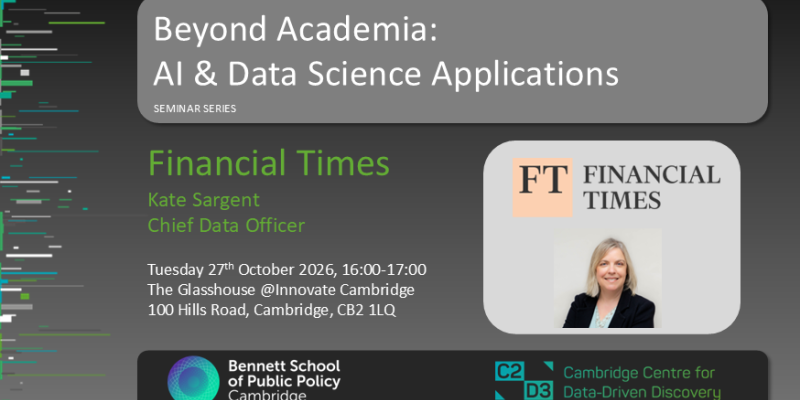
Careers Beyond Academia - Financial Times, Chief Data Officer Kate Sargent, Chief Data Officer, Financial Times

The Careers Beyond Academia Seminar Series provides PhD students and Early Career Researchers with realistic, experience-based insights into career pathways outside academia. Through invited talks from professionals working across industry and organisations, the series helps researchers understand how to successfully transition their skills and expertise into impactful roles beyond the university environment.

Statistics Clinic Easter 2026 IV

This free event is open only to members of the University of Cambridge (and affiliated institutes). Please be aware that we are unable to offer consultations outside clinic hours.


If you would like to participate, please sign up as we will not be able to offer a consultation otherwise. Please sign up through the following link: https://forms.gle/HdHM5kKYuxcdRPzr6. Sign-up is possible from June 18 midday (12pm) until June 22 midday or until we reach full capacity, whichever is earlier. If you successfully signed up, we will confirm your appointment by June 24 midday.

From Model Training to Model Raising: Toward LLM Alignment from Token Zero Prof. Robert West (EPFL)

Abstract: Current AI training methods align models with human values only after their core capabilities have been established, resulting in models that are easily misaligned and lack deep-rooted value systems. We propose a paradigm shift from "model training" to "model raising", in which alignment is woven into a model's development from the start.

Can an IP-based protocol stack be used for end-to-end communication in deep space? Prof. Carles Gomez, Universitat Politècnica de Catalunya

Abstract:

Title to be confirmed Donya Rooein (Bocconi University)


BSU Seminar: "Estimating conditional means under missingness-not-at-random with incomplete auxiliary variables" Maya Mathur, Associate Professor, Stanford Medicine

Estimators assuming missingness at random (MAR) can fail under missingness not at random (MNAR). Introducing complete auxiliary variables sometimes restores MAR by breaking dependence between analysis variables and missingness. However, if the auxiliaries are themselves incomplete, MAR typically remains violated.

Cambridge AI in Medicine Seminar - July 2026 Mengling Feng and Kai He

Sign up on Eventbrite: https://medai-july2026.eventbrite.co.uk