Margi Sheth, Head AI Governance & Enablement, Novo Nordisk
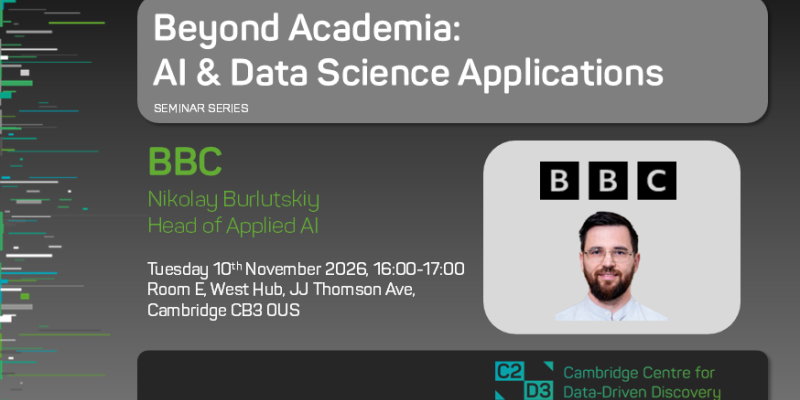
The Beyond Academia: AI & Data Science Applications seminar series at the University of Cambridge explores the transformative role of data and artificial intelligence in the world. Designed for postgraduate researchers, early-career academics, and students, the series bridges the gap between high-level research and real-world deployment.
Prof. Dr Pedro Beltrao, Associate Professor at the Department of Biology, Deputy head of Institute for Molecular Systems Biology, Institute of Molecular Systems Biology, ETH Zurich
Talk title: Protein interaction-based neural network models liking genotype to phenotype
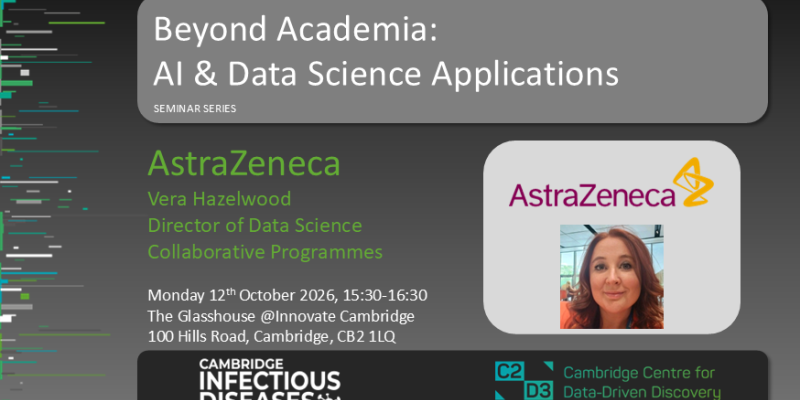
Vera Hazelwood, Director of Data Science Skills and Partnerships, AstraZeneca
The Beyond Academia: AI & Data Science Applications seminar series at the University of Cambridge explores the transformative role of data and artificial intelligence in the world. Designed for postgraduate researchers, early-career academics, and students, the series bridges the gap between high-level research and real-world deployment.
Wastewater-based epidemiology, although dating back almost a century, has undergone a renaissance since the last pandemic. By providing an aggregated signal of infections, it offers strong operational advantages over individual testing for tracking pathogens at the population level, but also introduces distinct analytical challenges.
Professor Michael Elliott, University of Michigan School of Public Health
Longitudinal data has become a major part of the landscape for clinical and epidemiological research. While variance is typically understood as nuisance – the “noise” in “signal-to-noise” – there is increasing evidence that underlying variability in subject-level measures over time may also be important in predicting future health outcomes of interest.
Christina Matteotti, Head of Universities, EMEA Partnerships, Google
The Beyond Academia: AI & Data Science Applications seminar series at the University of Cambridge explores the transformative role of data and artificial intelligence in the world. Designed for postgraduate researchers, early-career academics, and students, the series bridges the gap between high-level research and real-world deployment.
Dr Francesco Paolo Casale - Human Technopole, Milan, Italy; Helmholtz Munich, Munich, Germany; Faculty of Informatics, Technical University of Munich, Garching, Germany
Talk title: AI in Human Genetics: Linking Genetic Variation to Phenotypes Across Scales
The Beyond Academia: AI & Data Science Applications seminar series at the University of Cambridge explores the transformative role of data and artificial intelligence in the world. Designed for postgraduate researchers, early-career academics, and students, the series bridges the gap between high-level research and real-world deployment.
LLM agents are increasingly deployed on long-horizon tasks with tool use, irreversible actions, and unpredictable feedback. Yet we have few principled ways to tell, mid-episode, whether an agent is on track or quietly failing. Most uncertainty quantification (UQ) research still centers on single-turn QA, a poor match for interactive agents. In this talk, I'll present a general formulation of agent UQ and the challenges unique to agentic settings, from choosing uncertainty estimators to modeling how uncertainty evolves over an interaction.